

Difference of Trailer, Full Trailer, Semi-Trailer, Trailer Truck
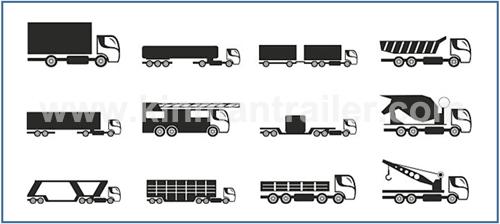
Trailer vs. Full Trailer vs. Semi-Trailer vs. Trailer Truck: Key Differences Explained
In road freight and cargo transport, the terms trailer, full trailer, semi-trailer, and trailer truck are often used interchangeably -- but they describe fundamentally different vehicle configurations. Understanding the distinction matters for equipment selection, regulatory compliance, and operational planning.
This guide explains each term based on weight distribution, coupling method, and real-world application. The core principle is simple: who carries the weight?
What Is a Trailer?
A trailer is any unpowered vehicle towed by a powered vehicle. It has no engine and relies entirely on the towing vehicle for propulsion. Trailers are used across agriculture, construction, logistics, and personal transport.
The term “trailer” is a broad category that includes both full trailers and semi-trailers. When someone says “trailer” without qualification, they usually mean a full trailer in technical contexts—but in everyday speech, it could refer to either type.
Key characteristics:
Unpowered, towed vehicle
Requires a towing vehicle for movement
Can be configured for many cargo types: flatbed, box, tank, refrigerated, etc.
What Is a Full Trailer?
A full trailer is a trailer supported by both front and rear axles. It is connected to the towing vehicle by a drawbar—a rigid towing structure that allows vertical movement but transmits no significant vertical load to the towing vehicle.
In other words, the full trailer carries 100% of its own weight. The towing vehicle provides traction and direction control only.
According to U.S. federal definitions, a full trailer is “designed to be drawn by another motor vehicle and so constructed that no part of its weight, except for the towing device, rests upon the self-propelled towing motor vehicle” .
Key characteristics:
Front and rear axles, both load-bearing
Drawbar coupling (also called a hitch)
Can stand independently when detached
Towing vehicle bears no vertical load
Steering front axle (on many designs)
Operational notes:
Full trailers offer high load capacity and adaptability to oversized cargo. However, they have a larger turning radius and, historically, exhibited stability issues at highway speeds—particularly fishtailing during braking. For this reason, many jurisdictions restrict full trailer use on high-speed highways .
Best for: Short-distance heavy haulage, farm operations, yard and port transport, and specialized applications where independent load-bearing is advantageous.
What Is a Semi-Trailer?
A semi-trailer is a trailer without a front axle. It attaches to a towing vehicle—called a tractor unit—via a fifth wheel coupling. A significant portion of the semi-trailer’s weight rests on the tractor, while the rear portion is supported by its own wheels.
This is the critical distinction: the semi-trailer does not carry all of its own weight. It is semi-supported.
When uncoupled from the tractor, a semi-trailer cannot stand on its own. It requires landing gear (retractable legs) to remain upright .
Key characteristics:
No front axle
Fifth wheel coupling to tractor unit
Weight distributed between tractor and trailer axles
Requires landing gear when detached
Better straight-line stability than full trailers
Operational advantages:
The semi-trailer’s weight-sharing design produces a smaller turning radius, better high-speed stability, and easier reversing compared to full trailers. The tractor and trailer can also be quickly separated, enabling drop-and-hook operations that reduce loading downtime .
Best for: Long-haul trucking, container transport, general freight, and the vast majority of modern road logistics.
What Is a Trailer Truck?
A trailer truck -- also called a semi-truck, tractor-trailer, semi-trailer truck, big rig, or eighteen-wheeler -- is the combination of a tractor unit and one or more semi-trailers.
The tractor unit is the powered vehicle. It has a cab, engine, and a fifth wheel coupling on the rear chassis. The semi-trailer attaches to this fifth wheel. Together, they form an articulated vehicle .
Key terminology note:
“Trailer truck” is a colloquial term. In technical and regulatory language, the components are distinguished:
Tractor unit: the powered towing vehicle
Semi-trailer: the unpowered cargo unit
Tractor-trailer combination: the complete vehicle
A tractor unit alone is not a “trailer truck” -- it becomes one when coupled to a semi-trailer.
Regional names for the same configuration:
North America: semi-truck, tractor-trailer, big rig, eighteen-wheeler
UK/Ireland: articulated lorry, artic
Australia: semi, B-double (for multi-trailer configurations)
Side-by-Side Comparison
| Feature | Full Trailer | Semi-Trailer | Trailer Truck (Combination) |
|---|---|---|---|
| Front axle | Yes | No | N/A (semi-trailer has no front axle) |
| Weight support | 100% self-supported | Shared: tractor + trailer | N/A |
| Coupling type | Drawbar / hitch | Fifth wheel | Fifth wheel |
| Can stand alone | Yes | No (needs landing gear) | No |
| Towing vehicle load | No vertical load | Carries front portion | N/A |
| Turning radius | Larger | Smaller | Smaller |
| High-speed stability | Lower (historically) | Higher | Higher |
| Typical application | Short-haul, heavy, farm | Long-haul, freight | Long-haul, freight |
| Common in modern logistics | Limited | Dominant | Dominant |
Why the Distinction Matters
For Equipment Selection
If you need a trailer that can be parked independently or used with a simple drawbar hitch, a full trailer may be appropriate. If you need maximum payload efficiency and highway stability, a semi-trailer is the standard choice.
For Regulatory Compliance
Vehicle definitions affect:
Maximum permissible dimensions and weights
Highway access restrictions
Driver licensing requirements
Inspection and safety standards
Full trailers face more restrictions than semi-trailers in many regions due to stability concerns at speed .
For Operations
Semi-trailers enable drop-and-hook operations: one tractor can serve multiple trailers, reducing downtime. Full trailers generally stay coupled to their towing vehicle and are less suited to this workflow.
Frequently Asked Questions
What is the main difference between a full trailer and a semi-trailer?
A full trailer carries 100% of its own weight on its own axles and connects via a drawbar. A semi-trailer has no front axle and rests part of its weight on the tractor unit through a fifth wheel coupling.
Is a semi-trailer a type of trailer?
Yes. A semi-trailer is a specific category of trailer. The broader term “trailer” includes both full trailers and semi-trailers.
What is a trailer truck called in different countries?
In North America: semi-truck, tractor-trailer, big rig, eighteen-wheeler. In the UK: articulated lorry, artic. In Australia: semi. All refer to the combination of a tractor unit and a semi-trailer .
Can a semi-trailer stand on its own?
No. A semi-trailer cannot stand independently when uncoupled. It requires landing gear (support legs) to remain upright .
Why are full trailers less common than semi-trailers today?
Full trailers have a larger turning radius and historically exhibited stability issues at highway speeds, including fishtailing during braking. Regulatory restrictions on highway use have limited their market share, while semi-trailers offer better high-speed stability and operational flexibility .
About Our Trailer Solutions
Kinman has a galaxy of Trailer Towing Parts, Trailer Hitch Parts, Trailer Body Parts, Trailer Axles and Axle Parts, etc. for different types of trailers, and also supplies Ratchet Straps, Corner Protectors, Rigging Hardware for Cargo Control applications.
For product inquiries, bulk pricing, or OEM/ODM requests, please contact our team.
Written by: Colin Ho, Product Office Boy
Date: Sep 17, 2026